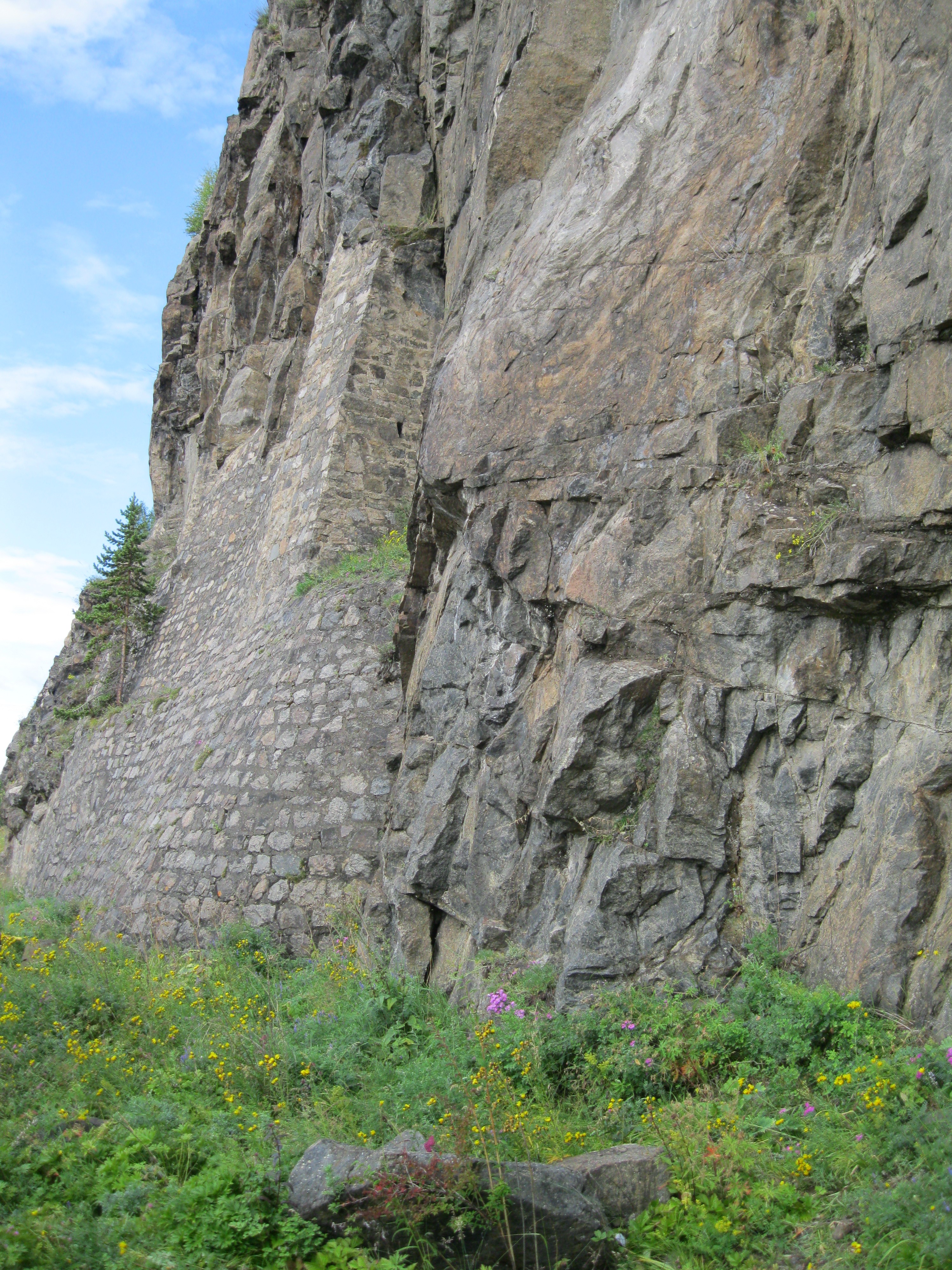
Retaining walls are among the most common structural elements on hillside properties in Canada. Their function is straightforward — they resist the lateral pressure of retained soil — but their design is shaped by several variables specific to Canadian conditions: frost depth, precipitation patterns, soil type, and the seismic zone classification of the site.
The Fundamental Load Cases
Every retaining wall must be designed to resist three categories of loading without overturning, sliding along its base, or inducing a bearing failure in the foundation soil:
- Earth pressure: The lateral force exerted by the retained soil mass. At-rest earth pressure applies where wall movement is prevented; active pressure is lower and governs where the wall can deflect slightly away from the soil.
- Hydrostatic pressure: If drainage is inadequate behind the wall, groundwater accumulates and adds hydrostatic load to the earth pressure. This is frequently the cause of retaining wall failures — not undercalculated soil loads but uncalculated water loads.
- Surcharge loads: Traffic, stored materials, or the weight of structures placed near the top of the retained slope generate additional pressure transmitted through the soil to the wall face.
Canadian Frost as a Design Driver
In climates where the ground freezes seasonally, the zone of soil behind a retaining wall is subject to frost heave — the volumetric expansion that occurs as water freezes within soil pores. When frost-susceptible soils (fine-grained silts and some clays) are retained, the heave forces can be substantial and are often eccentric, causing the wall to tilt forward progressively over several freeze-thaw cycles.
Several strategies address frost in Canadian retaining wall design:
- Granular backfill: Replacing frost-susceptible native soil behind the wall with clean granular material — typically a well-graded gravel — eliminates the capillary water movement that enables frost heave. The National Building Code of Canada and provincial codes generally require granular backfill behind basement and foundation walls; the same logic extends to freestanding retaining walls.
- Below-frost-line footings: Rigid concrete walls require their footings to extend below the design frost depth for the location. A wall with a footing above frost depth will be subjected to seasonal uplift that progressively undermines its stability.
- Drain tile and geotextile: A perforated drain pipe wrapped in geotextile fabric, placed at the base of the granular backfill zone, collects water before it can freeze and directs it to a safe outlet. The geotextile prevents fines from migrating into the drain and blocking it over time.
Wall System Types and Their Suitability
Cast-in-Place Concrete
Cast-in-place concrete walls — either gravity (mass) walls or cantilevered walls with a heel and toe footing — are the most structurally capable option and are typically specified for walls exceeding 1.5 m in retained height. They require formwork and a concrete pour, making them more expensive to construct than other options. However, their monolithic nature gives them the best resistance to frost-induced displacement, and they can be designed precisely to the loads calculated by the engineer. Weep holes or continuous drain pipe through the stem at the base are standard practice to relieve hydrostatic pressure.
Segmental Concrete Block
Segmental retaining wall systems — interlocking dry-stacked concrete blocks — became widely used in Canadian residential applications from the 1990s onward. They are flexible: the inter-block movement they permit accommodates minor settlement and frost heave without cracking. For walls under about 1.2 m in height, many municipalities permit construction without engineered drawings. Beyond that height, the National Concrete Masonry Association (NCMA) design method or an equivalent is typically required, and geogrid reinforcement extending back into the retained soil is necessary.
The critical limitation of segmental wall systems in wet climates — such as the BC coast or Atlantic Canada — is that their permeable nature does not prevent water from entering the backfill zone. Drainage design remains as important as it is for solid walls.
Gabion Walls
Gabion walls are constructed from wire mesh cages filled with rock. Their main advantage in hillside applications is permeability — water drains freely through the wall face, essentially eliminating hydrostatic pressure as a load. They are also relatively tolerant of differential settlement, making them suitable on sites with variable foundation conditions. The wire mesh baskets corrode over time, but modern galvanised or PVC-coated systems extend service life considerably. Gabions are well-suited to naturalistic settings and can support revegetation between the rock-filled units.
Timber Crib and Post-and-Plank Walls
Timber walls are common in older residential developments and rural applications. Pressure-treated lumber or naturally durable species — cedar, Douglas-fir — are typically used. In the current Canadian regulatory context, walls using chromated copper arsenate (CCA) treated timber are subject to restrictions on use near water. Timber walls generally have a shorter service life than concrete or stone systems, and the decay rate is accelerated in wet climates. They are generally not recommended for walls exceeding 1.0–1.2 m of retained height or for applications where failure would endanger structures or persons.
In British Columbia, walls over 1.2 m in retained height typically require a permit and engineered drawings. Alberta follows similar thresholds under its Safety Codes Act. Always confirm the specific trigger height in the relevant municipality before commencing design.
Drainage is Not Optional
Industry post-mortems on retaining wall failures in Canada consistently identify inadequate drainage as the leading contributing factor. The sequence is predictable: drainage is omitted or poorly specified during construction, water accumulates behind the wall during spring snowmelt or a heavy rainfall event, hydrostatic pressure builds, and the wall fails — sometimes suddenly. Even where drainage is designed, construction inspection is needed to confirm that the drain pipe is not damaged, backfilled with fines, or terminated without a clear outlet.
The outlet of any wall drain must discharge to a point where the concentrated flow will not cause erosion or undermine the wall's foundation. On steep slopes, energy dissipation at the outlet — through riprap aprons or check structures — is often specified.
Wall Inspection and Maintenance
Retaining walls should be inspected annually by the property owner and periodically by a qualified engineer. Signs warranting immediate professional review include:
- Visible forward lean or rotation of the wall face
- Horizontal cracking in concrete or masonry walls
- Blocked or non-functioning weep holes
- Settlement or cracking in the surface behind the wall crest
- Erosion of soil at or below the wall toe
- Seepage emerging from the base or face of the wall between weep holes
Walls that have been in service for more than 25 years without inspection warrant an engineering review even in the absence of obvious distress, particularly if the retained height or surcharge loading has changed.
Retaining wall design must be performed by a registered professional engineer. Provincial permit requirements vary; confirm applicable regulations with the relevant municipal building authority.